Nalina Moses

ARCHITECT, WRITER, CURATOR

  • BLOG
  • SINGLE-HANDEDLY
  • WRITINGS
  • EVENTS
  • ABOUT
  • CV
  • CONTACT
WS, Paul McCarthy’s multimedia installation at the Armory, fills the Drill Hall with spectral howls and lighting, thick-limbed artificial trees, a ravaged suburban house, and a three-screen seven-hour movie that’s projected simultaneousl…

WS, Paul McCarthy’s multimedia installation at the Armory, fills the Drill Hall with spectral howls and lighting, thick-limbed artificial trees, a ravaged suburban house, and a three-screen seven-hour movie that’s projected simultaneously at each end of the space.  The film is a dark, dirty retelling of the Snow White story.  The house, a recreation of the artist’s childhood home in suburban Utah, is actually the stage set where it was filmed.  That filming has left it wrecked, with soiled rugs, spoiled foods, overturned furniture, and naked, mutilated corpses.  The whole experience might be shocking but instead it’s tedious; so over-the-top that it has little emotional punch.  The most powerful view is from the Mezzanine, from where all the systems sustaining the fantasy (scaffolding, lights, wiring, security) can be seen.  I visited on a beautiful summer afternoon, and after surveying the installation and watching the film for about ten minutes, waiting for the narrative to take hold, I was itching to step back outside.  The Times hyped the show with a review that compared McCarthy to Jonathan Swift and Heironymous Bosch.  I liked the review on Culturebot better, Paul McCarthy’s ‘WS’ is BS.

WS takes aim at the aesthetic and moral emptiness of middle class Americans, living in the suburbs and vulnerable to Disneyesque fantasies.  It’s an easy critique for city-dwelling art world types, and one everyone is familiar with.  But the show left me wondering why it’s so hard to be clear-eyed about the suburban house.  When we see this loaded architectural form in the media it’s either sanitized (like the spreads in Living and Dwell) or trashed (like in WS).  McCarthy vision of middle America is clear, but lacks the ravishing precision of David Lynch’s, which narrows in on common sounds, sights and juxtapositions – a poetics of the everyday– to expose latent strangeness and violence.  WS adds little to our understanding of suburban life or the Snow White story.  In fact its super-sized scale only highlights the emptiness of the artwork itself.  It’s this installation, really, that has issues.

WS, by Paul McCarthy, Park Avenue Armory, 2013.  Photograph by James Ewing.
August 08, 2013 by Nalina Moses
August 08, 2013 /Nalina Moses /Source
INSTALLATION, FILM, Snow White, Walt Disney, suburbs, Paul McCarthy, McCarthy, WS, Armory
Comment
The most lyrical passages in The Yellow Birds, Kevin Powers' novel about a United States soldier who served in Iraq, are those that describe the geography: of Virginia, from where he hails and to where he returns, and of Nineveh Province, where he f…

The most lyrical passages in The Yellow Birds, Kevin Powers' novel about a United States soldier who served in Iraq, are those that describe the geography: of Virginia, from where he hails and to where he returns, and of Nineveh Province, where he fights.  With brief stops at the barracks in Fort Bragg, New Jersey and a whorehouse in Kaiserslautern, Germany, the story shifts between Richmond and Al Tafar, building drama by overlaying the landscapes of America and the Middle East, forest and desert, tradition and modernity, violence and sterility.  The narrator has a keen memory for the spread of earth around him (the plants, the sounds, the light, the air) and relates them to us exquisitely.  Of the rising sun he says, "… a light the color of unripe oranges fell…“  Of the night sky he says, ” …  a few stars like handfuls of salt thrown out.“  And he understands how deeply the landscape shapes identity and memory.  Of an orchard he says, ”… the trees planted in rows so orderly we thought we’d have views from one world to another.“

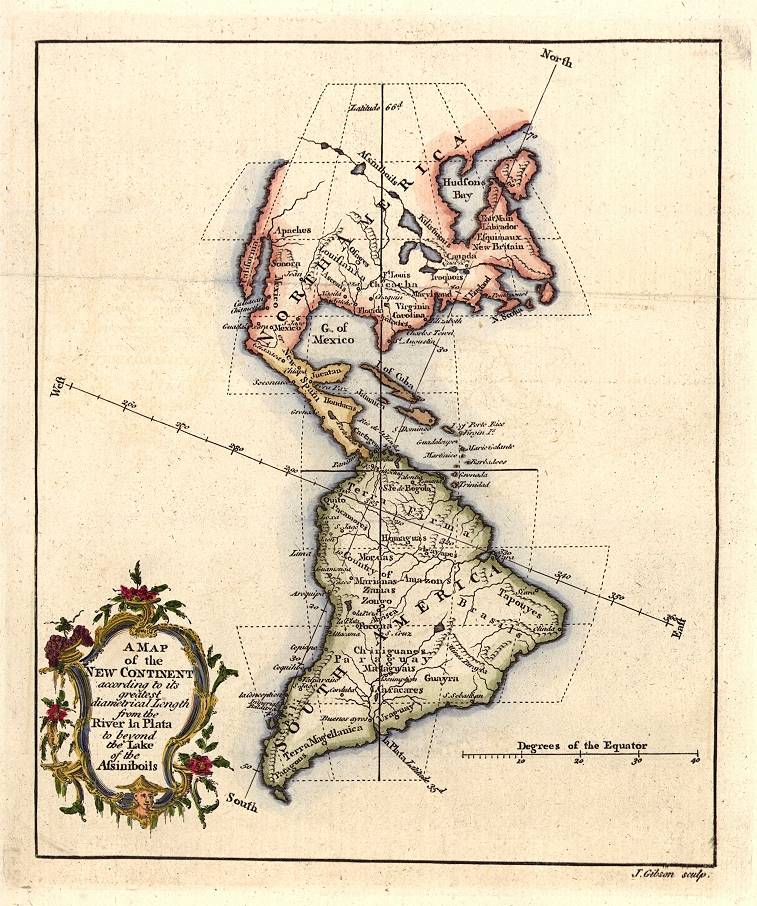
While the themes of the book are timely, stirring up discussion about parts of our current national policy we don't really like thinking about, it’s its description of Iraq that haunts.  The Iraq in the book is a real place, with hyacinth gardens and sewage ditches, with three-legged donkeys and beautiful old women.  It’s a landscape that is being devastated, without clear reason, by gunshot, explosions and fire.  The soldier’s memories of this place, which stay with him, are his memories of the war.  At the end of the book, after he’s back in the States, a visitor gives him a map of Iraq and he thinks, "That map, like every other, would soon be out of date, if it was not already… the map would become less and less a picture of a fact and more a poor translation of memory in two dimensions."  There’s a way in which every story is a map, and every map is exactly that, an attempt to put a world we know on paper.

A Map of the New Continent, by J.Gibson, The Gentleman’s Magazine, 1758.

August 01, 2013 by Nalina Moses
August 01, 2013 /Nalina Moses
The Yellow Birds, Kevin Powers, FICTION, MAPS, GEOGRAPHY
Comment
Gravity and Grace, the show of sculpture by El Anatsui at the Brooklyn Museum, is well named.  The artworks, giant nets made from scraps salvaged from discarded bottlecaps, cans, and printing plates, have an imposing scale and complexity and a light…

Gravity and Grace, the show of sculpture by El Anatsui at the Brooklyn Museum, is well named.  The artworks, giant nets made from scraps salvaged from discarded bottlecaps, cans, and printing plates, have an imposing scale and complexity and a light, fluid presence.  They’re evocative: of fishing nets, molecular structures, chain mail, Navajo blankets, and pixellated imagery.  They feel more like fabrics than like artworks, and I wanted nothing more than to get a piece and make a gown with it, in which I could parade triumphantly through the museum as the waves of metal bits glittered and swished around me.  One friend I was with warned, “That dress is going to be scratchy.”

While all the sculptures are engaging, I’m confused by their presentation.  Some are pinned to the wall with deep folds and bumps, and have tendrils that spill onto the floor.  Some have internal frames and stand on their own  And some are draped from wires like bedsheets hanging to dry.  El Anatsui’s works fall somewhere between painting and sculpture – field and figure – but I can only see them as textiles.  And I wanted the works to be displayed very simply, squared-off and pinned flat against a blank wall.  Some of the freestanding sculptures have great power.  A field of knee-high mounds constructed from gold soup can lids rises from the floor like a swarm of sea creatures.  But the most sophisticated pieces are those fashioned from bottlecap scraps.  These metal bits are hammered flat like ribbon, folded into squares, or puckered like flowers, and then tied together, one by one, by the thousands, with thin twists of wire.  The contrast in the sizes and colors of these scraps, and between the larger fields in which they’re laid, give the panels rich overlapping rhythms.  One looks and gets lost inside.  These pieces don’t need to be shaped sculpturally or flooded with sunlight or blown with fans (as one piece in the show is).  They are magical surfaces; they have life.

El Anatsui (Ghanaian, b. 1944). Amemo (Mask of Humankind) (detail), 2010. Courtesy of the artist and Jack Shainman Gallery, New York. Photograph by Andrew McAllister, courtesy of the Akron Art Museum.

July 24, 2013 by Nalina Moses
July 24, 2013 /Nalina Moses /Source
Comment
A little exhibit at the Schomburg Center in Harlem tracks the history of Africans who were brought to India as slaves, focusing loosely on the sixteenth and seventeenth centuries.  It’s not much of an installation: about two dozen large printe…

A little exhibit at the Schomburg Center in Harlem tracks the history of Africans who were brought to India as slaves, focusing loosely on the sixteenth and seventeenth centuries.  It’s not much of an installation: about two dozen large printed boards with texts that relate, in a matter-of-fact tone, the stories of some of the most accomplished Africans in India, illustrated with some not-so-great reproductions of paintings and photographs.  But the content of the exhibit – slavery in India, the assimilation (and acceptance) of Africans into Mughal culture, the against-all-odds success stories of some brilliant men and women – is dazzling.  I went to the exhibit with my parents, who were raised and educated in India, and none of us had any idea that Indians participated in the slave trade.  A staff members at the Center told us that many Indian-Americans arrived excited to see the show, and then left protesting that none of it was really true.  But it is.

One particular painting in the exhibit, Sultan Muhammad ‘Adil Shah and Ikhlas Khan riding an Elephant, from 1650, is particularly shaming.  I know this miniature well.  It was the key image of an 1985 exhibit about Indian art at the Met that my parents took me to.  I bought a notecard of it which I still have and keep at the very bottom of my stationery bin, because I don’t want to part with it.  It shows the two men and the beast in bold graphic profile against a thick, midnight blue sky.  The Sultan, with gold robes and a halo, rides cross-legged at the top of the bedecked and bejeweled elephant.  Khan, a smaller and darker man, sits in back, on the elephant’s rear, and fans the Sultan with a white towel.  I’ve looked at this image about a hundred times without really seeing the second man and wondering who he is.  He is, in fact, a freed Abyssinian slave, formerly named Malik Raihan Habshi, who, through ambition and hard work and at least one murder, was anointed Ikhlas Khan and rose to the position of ‘Adil Shah’s chief minister.  He was a decision-maker who ran the Bijapur sultanate which 'Adil Shah, in title, led.  The refusal to see this man in this painting, and in the history of India, is telling.


July 17, 2013 by Nalina Moses
July 17, 2013 /Nalina Moses /Source
PAINTING, MINIATURE, India, Africa, RACE, Ikhlas Khan
Comment
  • Newer
  • Older